
Edel Assanti, Bury St
Marcin Dudek
10.June.26 – 14.August.26
Edel Assanti presents Gate III, a presentation of works by Marcin Dudek in anticipation of his solo exhibition PAWILON at the gallery’s Fitzrovia space in October 2026, and his specially-designed booth for the gallery’s presentation at Frieze London, also opening in October 2026.
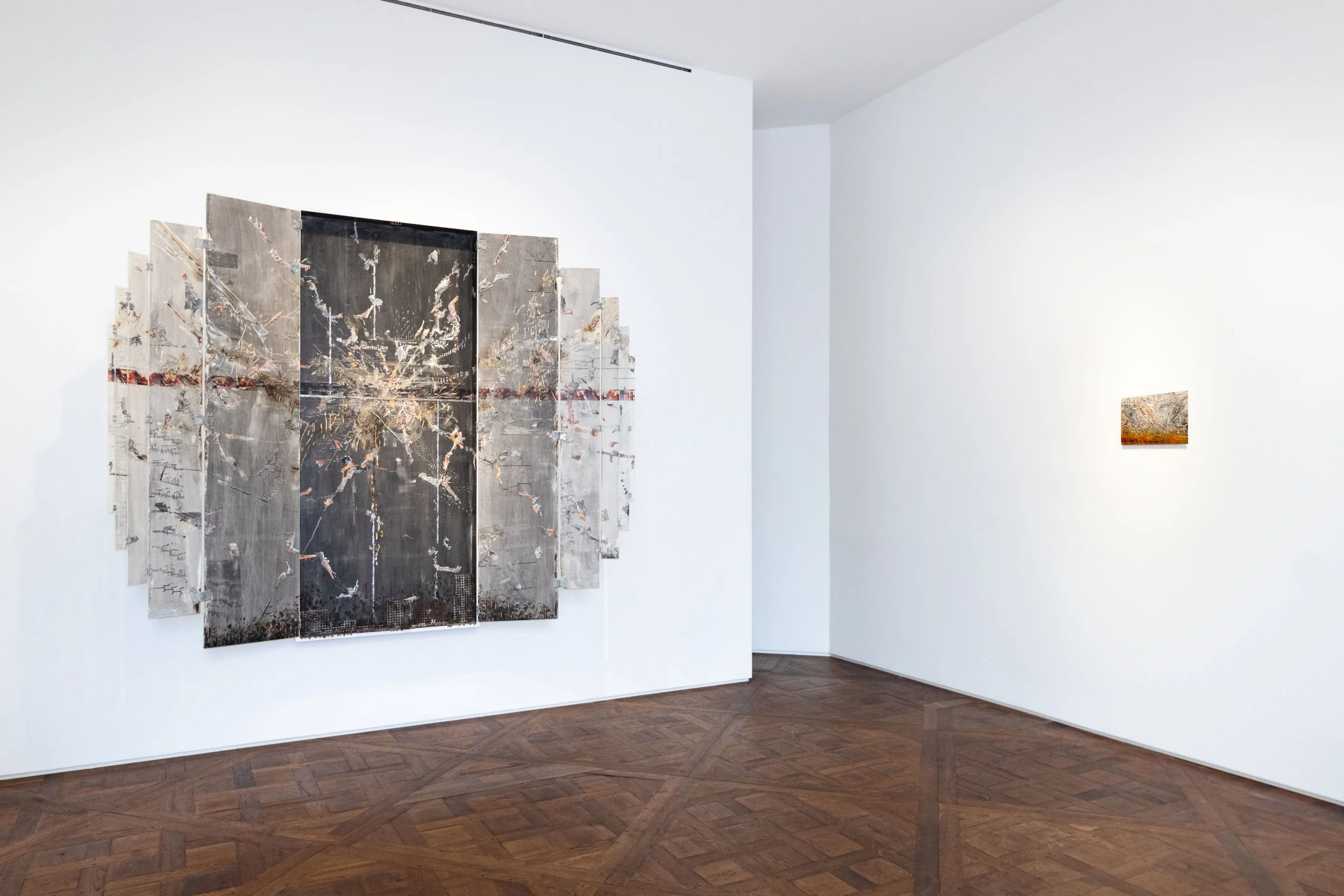
Oskar Hansen’s Open Form theory describes a flexible structure, which invites the public to interact with and participate in its process of continual transformation; it can exist at any scale, from film strips to large apartment complexes. In this work, the most recent work from the Gate series, Marcin Dudek draws inspiration from Hansen’s "rhythm exercises", a visual game developed with students at the Warsaw Academy of Fine Arts. From a quiet, self-contained rectangle, Gate III unfolds into eleven separate segments, whose delicate hinges can be placed in almost as many positions as the viewer can imagine, including a configuration where the work completely envelops the spectator.
The Gate series depicts moments of transformation, emerging from the artist’s personal experience with subjects such as survival economies and sports mega-events. The architecture of the arena returns as a leitmotif throughout Dudek’s work, representing power dynamics, crowd psychology, and a space of both exaltation and traumatic memory. The closed form of Gate III borrows from stadium entrances, narrow openings designed to admit one body at a time, a safeguard against the violence of mass movements.
As it opens, the polyptych progressively reveals a landscape. Its horizon line is formed by stills of a pyrotechnic display, conducted by Ultras at the Krakow Derby: at its center, the still-distinguishable crowd lights a flare; as the line extends outwards, flames increasingly engulf the image. The wooden panels lighten and taper, as the explosive encounter echoes outside of the stadium, its smoke blanketing the city. The external regions of the landscape are occupied by cross-sections of stadium terraces, like skeletal blueprints for a spectacle to come. Crowds, seen from above, stream from every corner towards the central panel, passing over charred carvings and crossroads made from razor blades – studio waste turned ornament. At the centre, these masses collide, in flashing pulses of scratched lines and vivid colour.
As the viewer plays with the possible compositions of this landscape, the spectacle is replayed, the individual entrance loses its authority, the aerial view finds itself constantly reconfigured. At the margins of the image, on the very bottom of the central panel, dust from settling nerves has coated the metal frames of housing blocks, seen from afar on a long walk home.
Info + opening times
Edel Assanti