
Thomas Dane Gallery
Glenn Ligon
13.October.26 – 19.December.26
In Prompts, Glenn Ligon’s sixth exhibition with Thomas Dane Gallery, the artist has assembled a group of earlier and new works which conspicuously inform, contextualise, re-contextualise, appropriate and, somehow, ‘prompt’ one another.
One of the most enduring and original aspects of Ligon’s practice is the way he has—through subtle alterations and re-framing—created bodies of work in a continuous, self-referencing process over years, sometimes decades. Nowhere is this more evident than in the numerous variations of his emblematic ‘AMERICA’ neons, which for over twenty years have served as both an insight into the artist’s meticulous approach, and as an ingenious and elliptic parable for the country itself.
The two giant works mirroring each other in the front gallery, Untitled (America) and Untitled (Double America) (both 2026), were originally templates for fabricators and installers to shape and hang each neon letter of Rückenfigur (2009) and Double America (2012), works in which Ligon sequentially flipped and combined the letters from earlier neons. From matrix to remnants, the templates now mark out the solarised vestiges and ghostly, quasi-burnt outlines of the neons, adding another layer to the artist’s ambivalent relationship to American history.
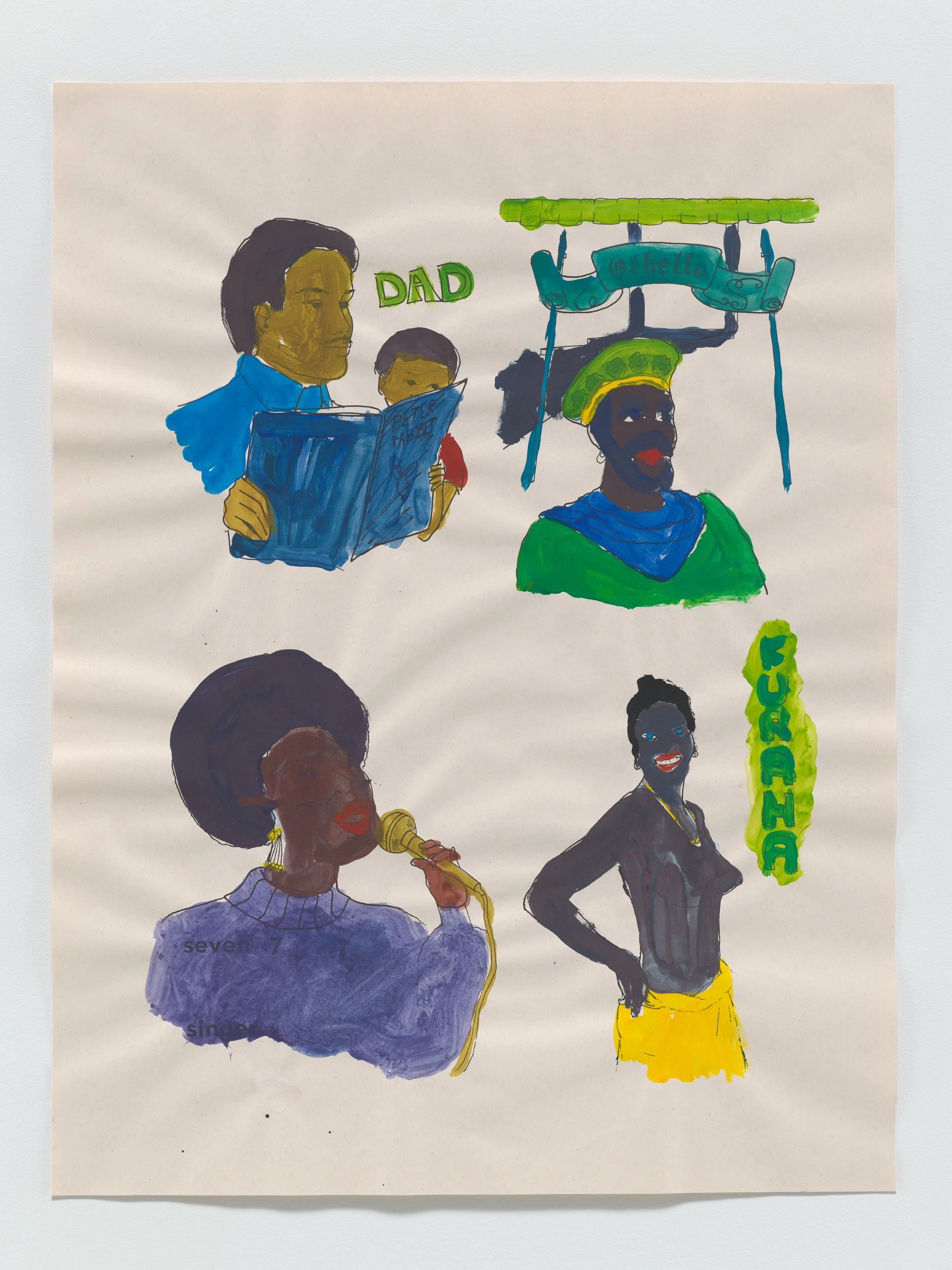
In 1999, Ligon began a year-long residency at the Walker Art Center in Minneapolis, where he invited local children to colour in pages from Afrocentric colouring books from the late 1960s and early 1970s, published by Johnson Publishing Company among others. The result was a feast of loud, colourful scribbles and smudges, bringing a childlike innocence to images of Black American heroes such as Malcolm X, George Washington Carver and Frederick Douglass, and later prompting Ligon’s own series based on the children’s drawings.
Afrocentric colouring book pages also serve as the prompt for Ligon’s newest work, Black Panther Coloring Book #2 (2026). The source material, Akinsanya Kambon’s twenty-two drawings, realised in 1968 for the Black Panther Party for Self-Defense as a visual history of racial and social injustice, remains a divisive opus to this day. Here, Ligon has covered the images of Kambon’s original suite with black oil-stick rectangles, leaving only the text and a few details visible, in a nod to the redactions of government files and perhaps also to the cinematic technique of hors-champ, or what lies beyond the frame, sensed but never shown. Injunctions such as “POWER COMES THROUGH THE BARREL OF A GUN” prompt the viewer to imagine the image beneath.
To emphasise such artifice, Ligon also presents a new painting, Redacted #15 (2026), featuring the practice of using the “X” on a manual typewriter to remove a mistake. The redacted text is an excerpt from James Baldwin’s 1953 essay ‘Stranger in the Village’, which has featured extensively in Ligon’s oeuvre since 1996. Ligon’s semiotic gesture amounts to a form of self-critique and self-cancellation—a meaningful signal in an era where, once again, Black and queer voices such as Baldwin’s are being erased from the public discourse.
Info + opening times
Thomas Dane Gallery