
Carl Kostyál
Shane Keisuke Berkery
03.April.25 – 05.May.26
Carl Kostyál presents ‘Shane, Come Back’, a presentation of eleven new paintings by the Irish-Japanese artist Shane Keisuke Berkery (b. 1992), marking the artist’s debut solo exhibition with the gallery and in London.
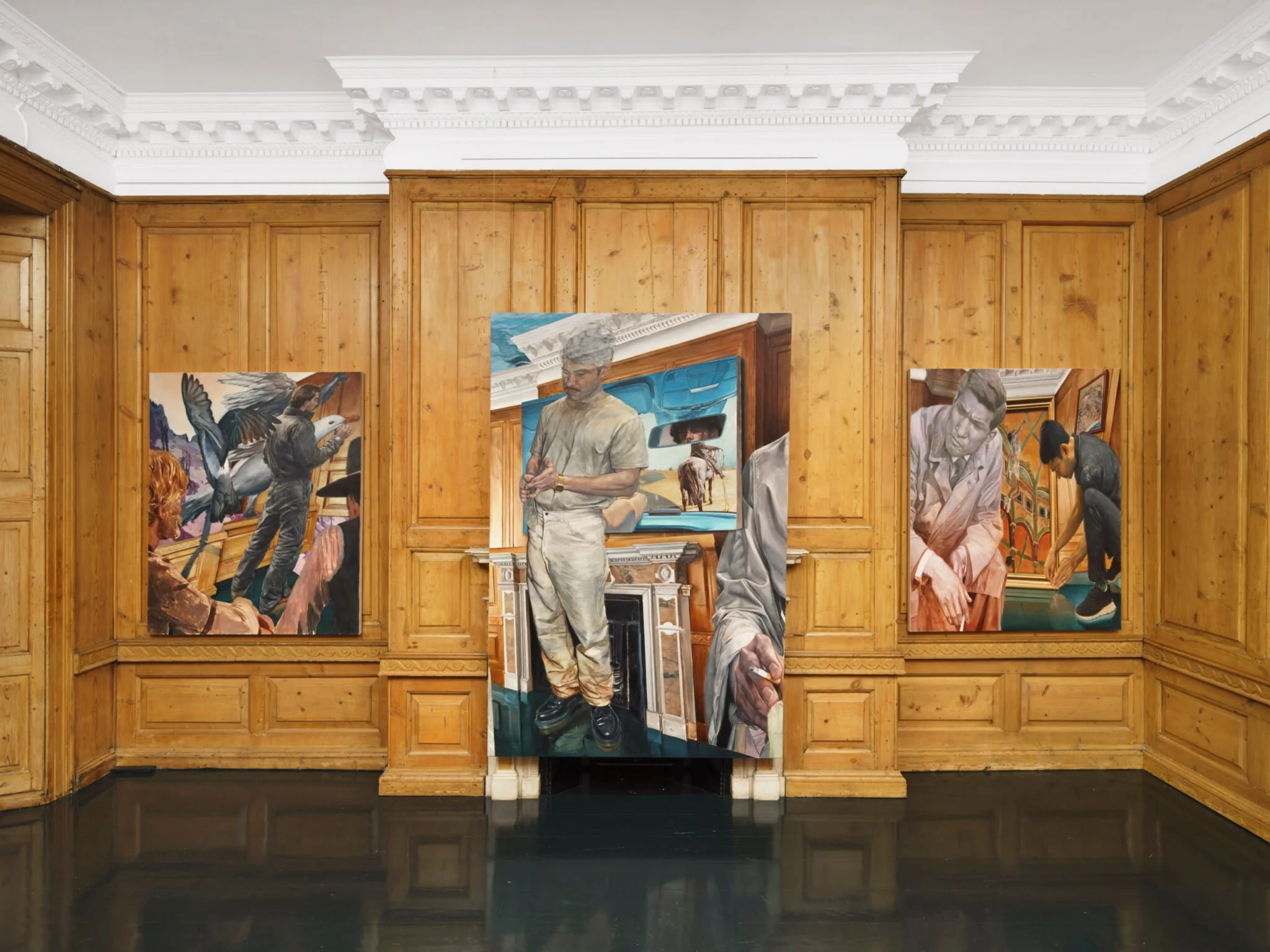
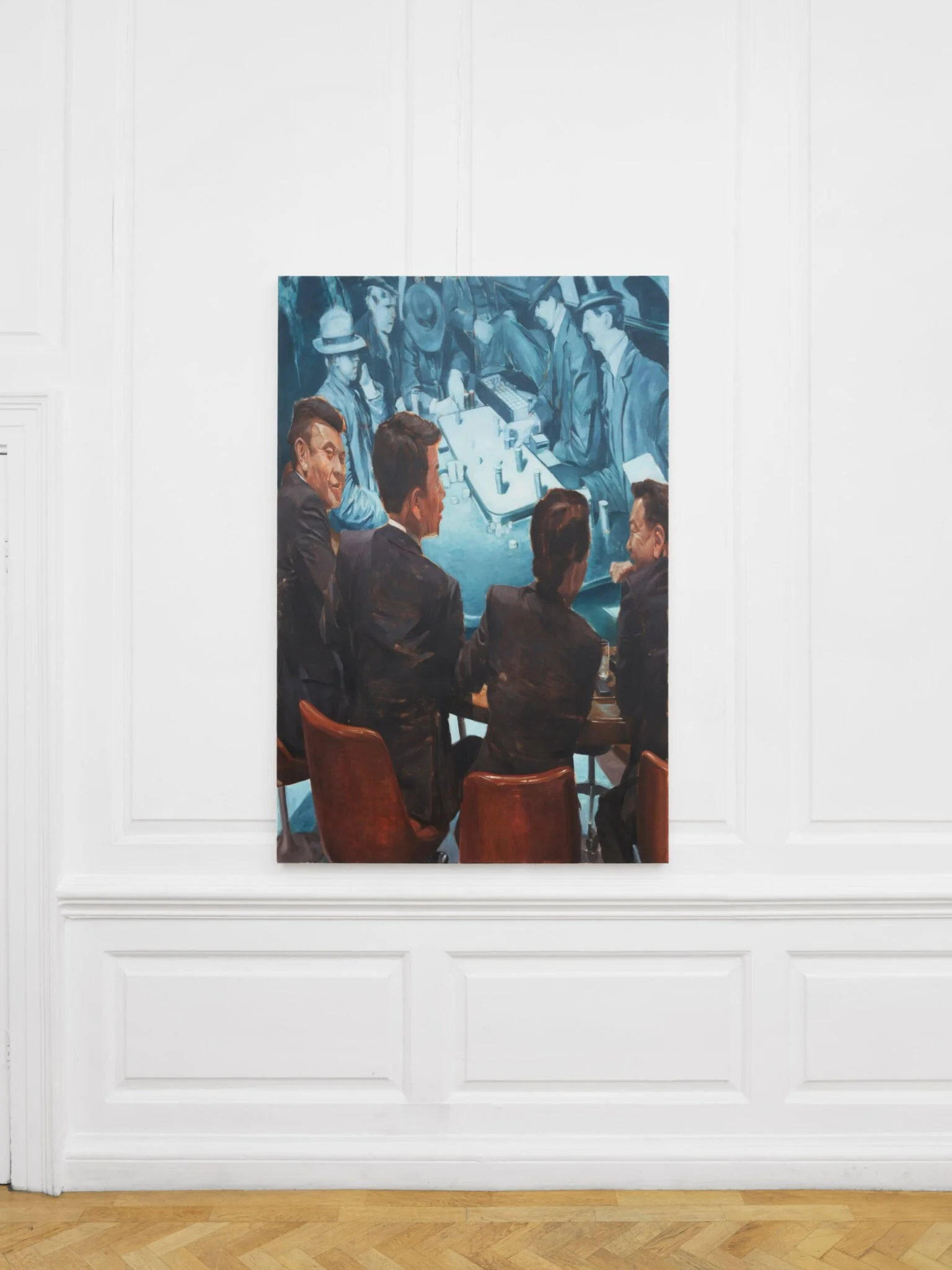
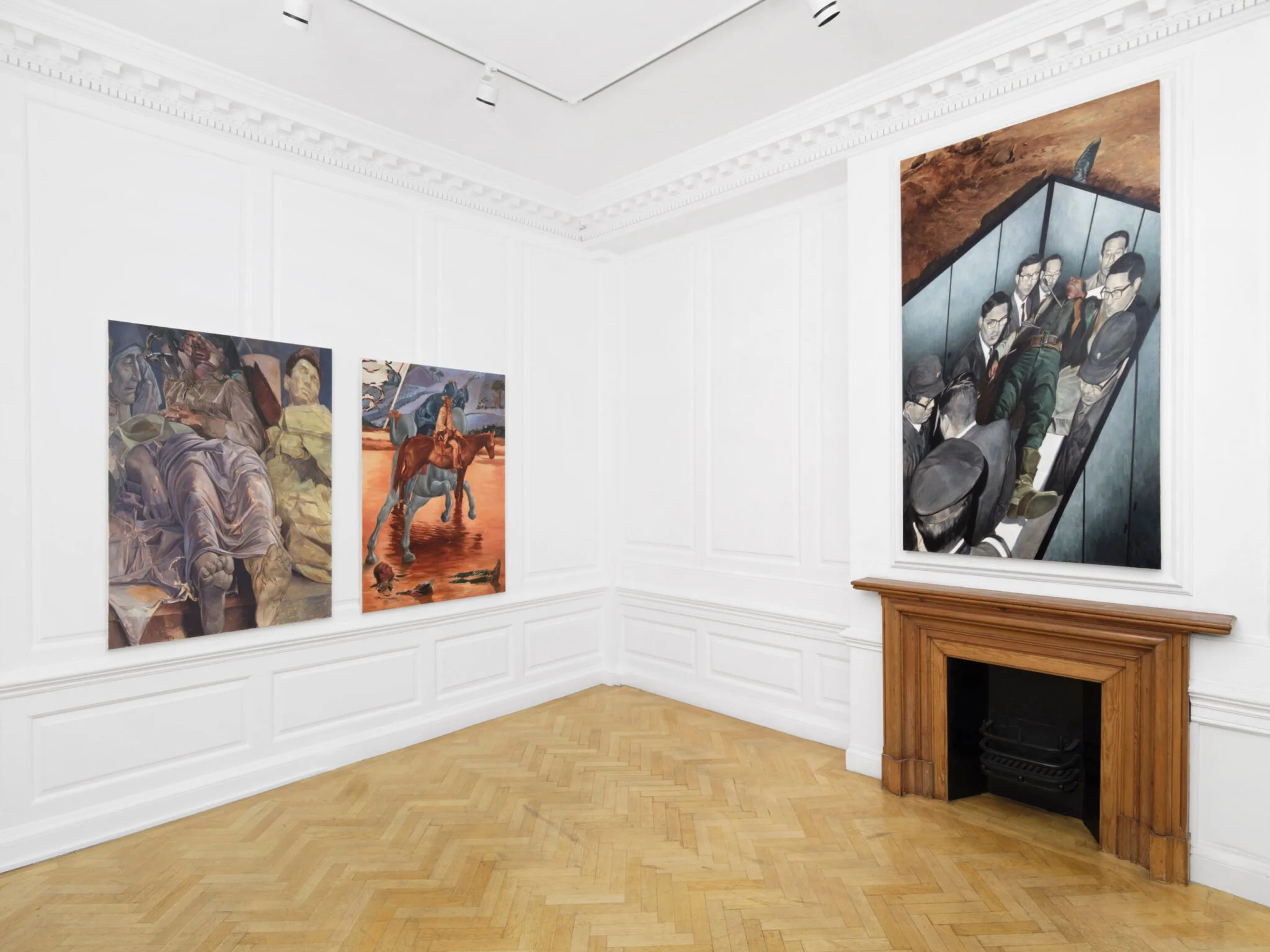
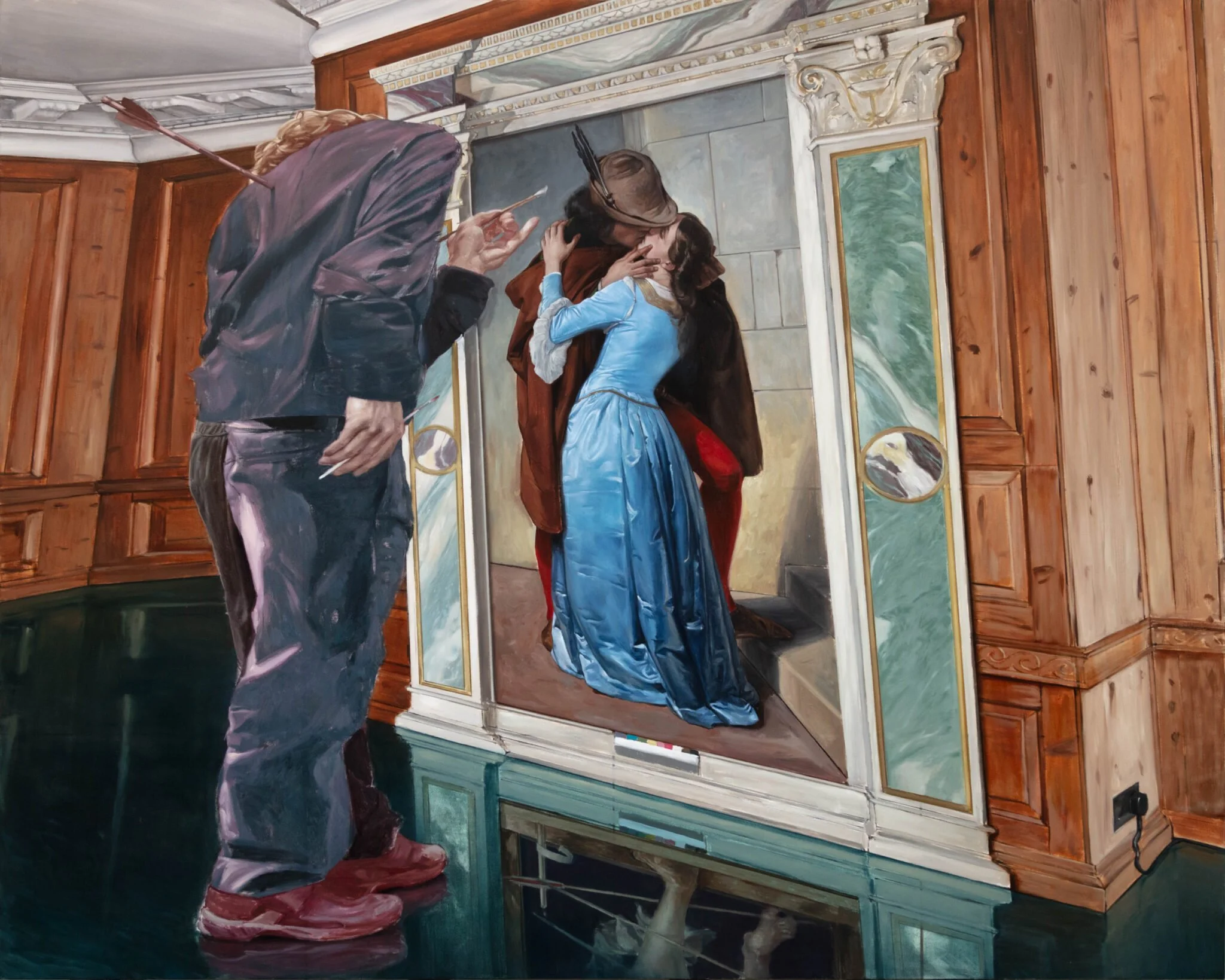
“Shane Keisuke Berkery (b. 1992) is an Irish-Japanese painter who was born in Japan, moved to the USA as a child, then to Ireland, studying at the NCAD in Dublin then later for his MA at the Royal College of Art in London, where he now resides. Such a transnational upbringing, with all the upheaval and radical adjustment to language, culture, social codes and expectations that accompany it, is key to a decoding of his complex pictorial compositions. The only constant in his peripatetic life has been making art. The central preoccupation in his practice is his clear sense that identity, far from being something fixed or culturally singular, is contingent, and requires continual negotiation.
His paintings teeter on the threshold of internal and external worlds, of lived reality and its narration, of stability and instability, both of memory and of the picture plane itself. Personal memory and collective myth collide. For the artist, consciousness and memory are not linear. The mind does not store experience in neat sequences but in fragments – photographs, films, inherited images and stories, historical events learned, private memories recalled – all co-exist simultaneously. These fragments, drawn equally from his life and from what the artist has described as ‘the constant flow of mediated images’ become in his paintings reference points through which the self is understood and projected. His works are not depictions of scenes so much as constructions of psychic space, compressed environments in which multiple temporalities and image registers collide.
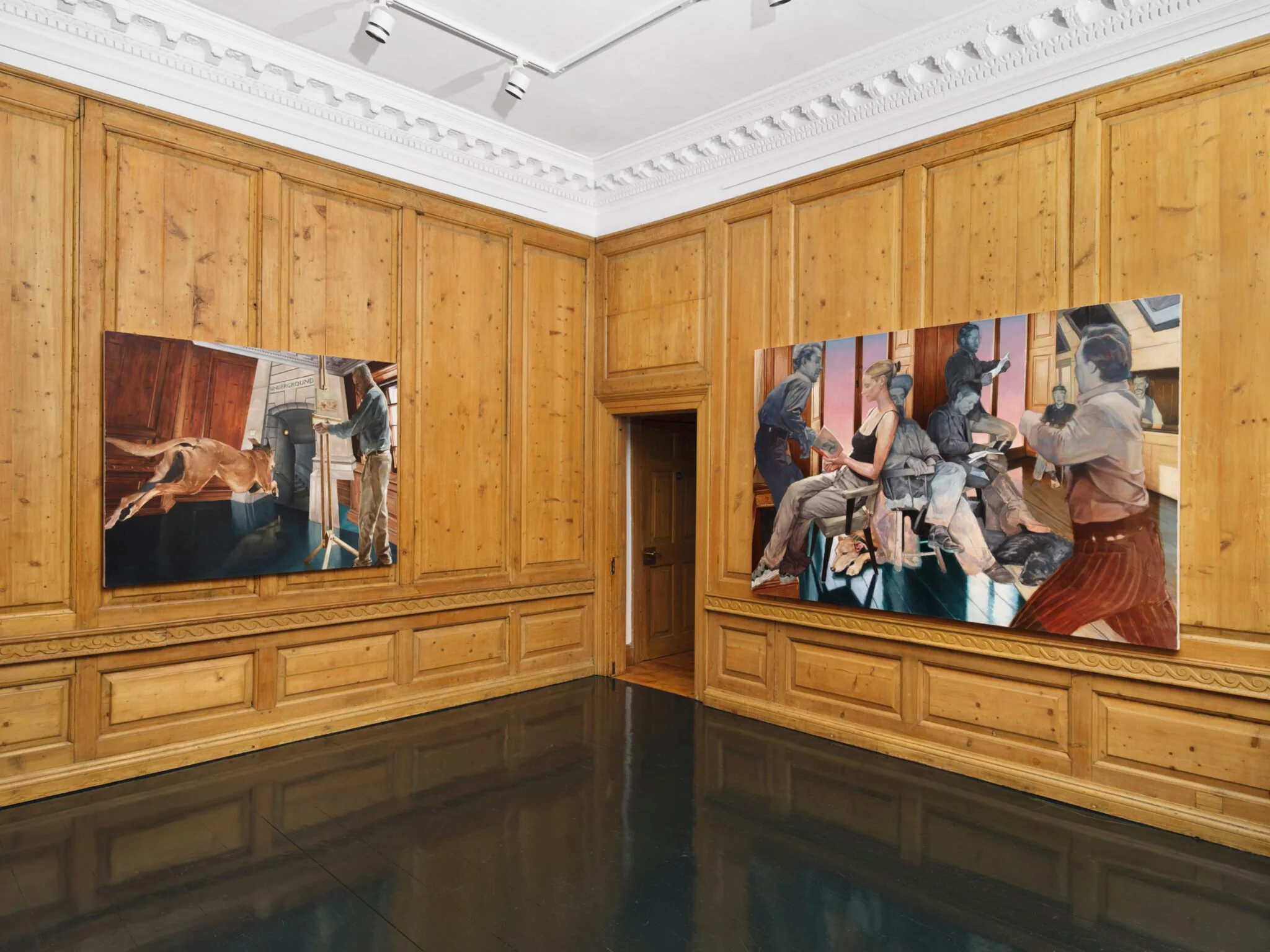
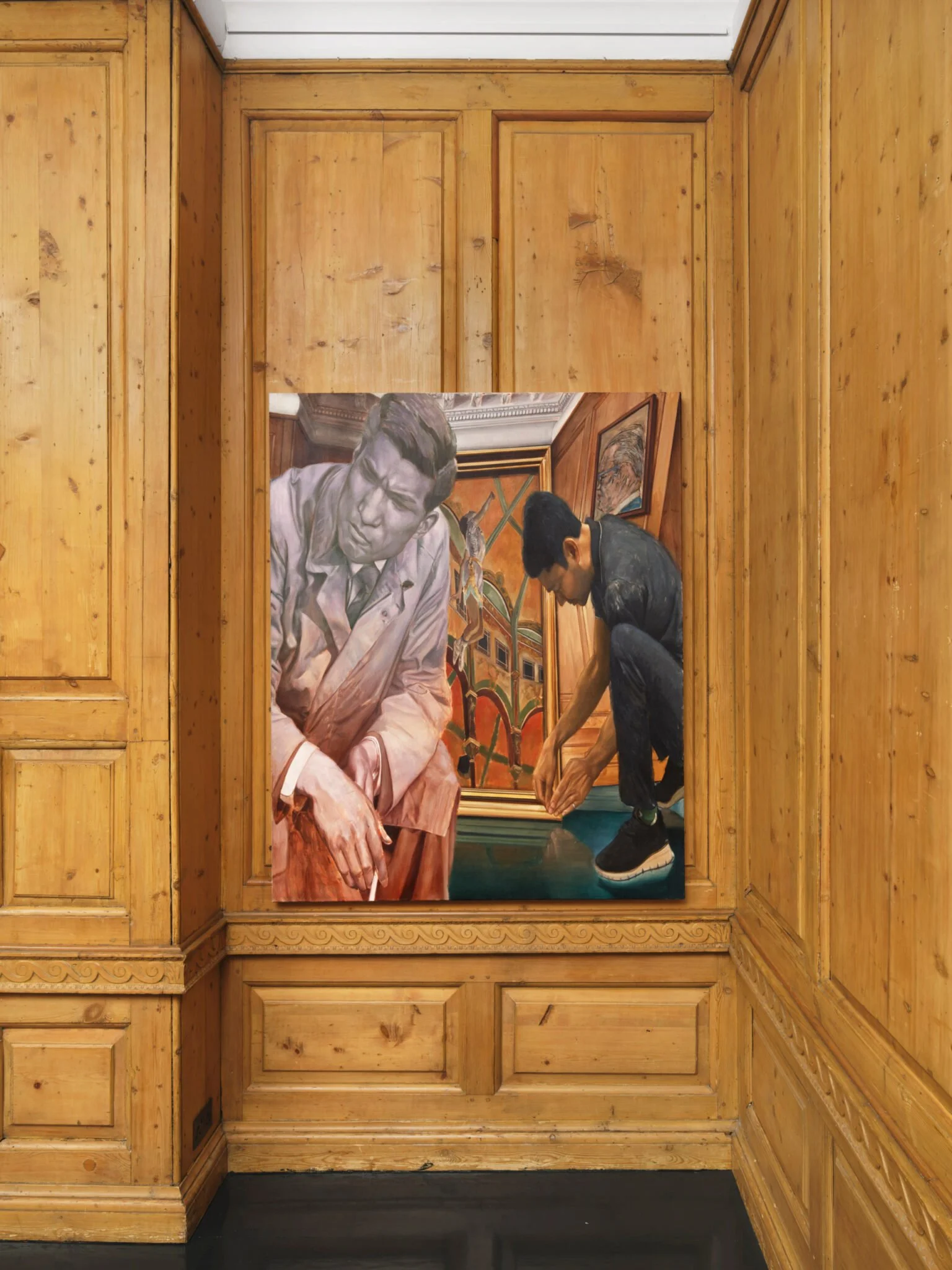
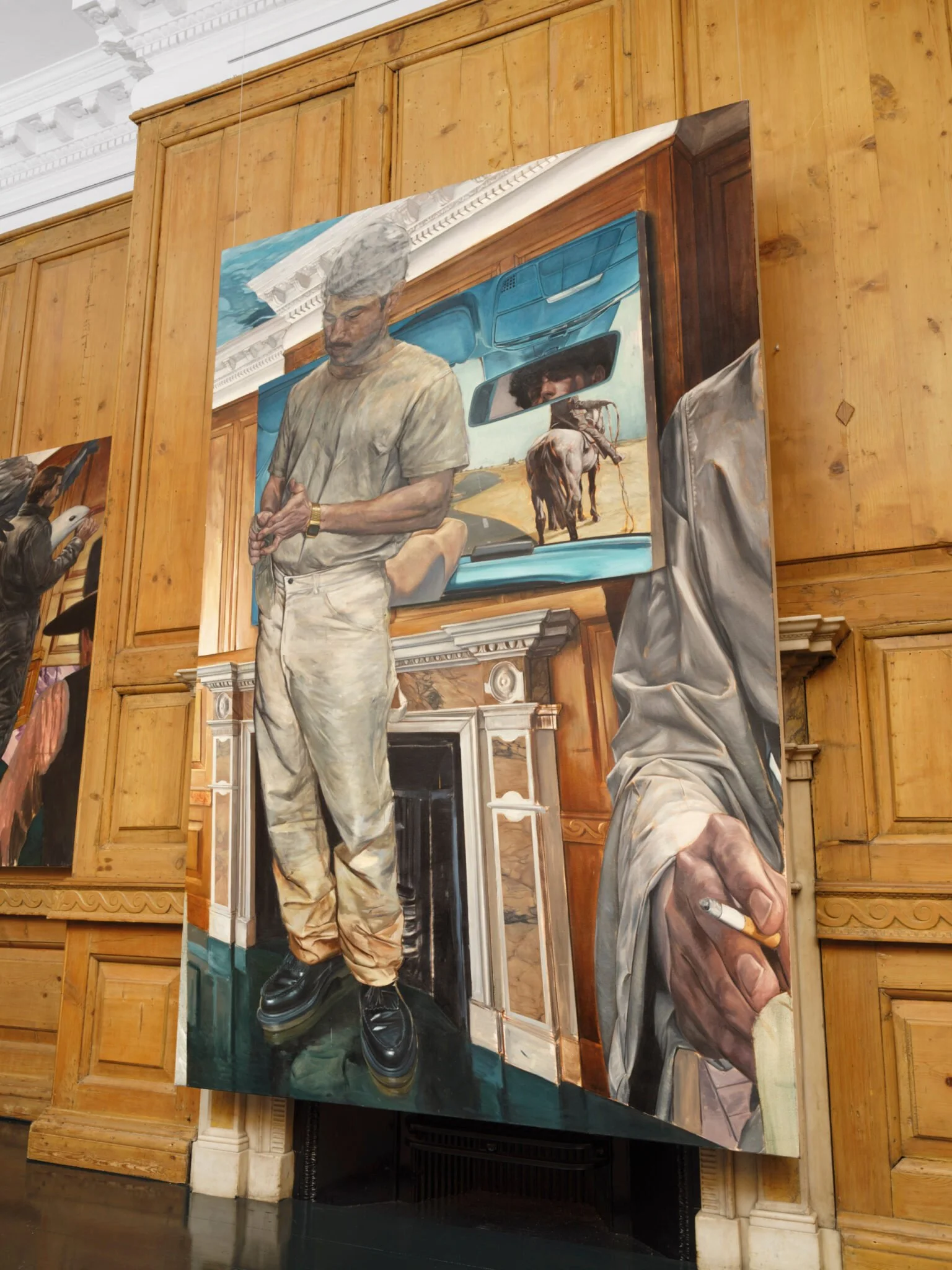
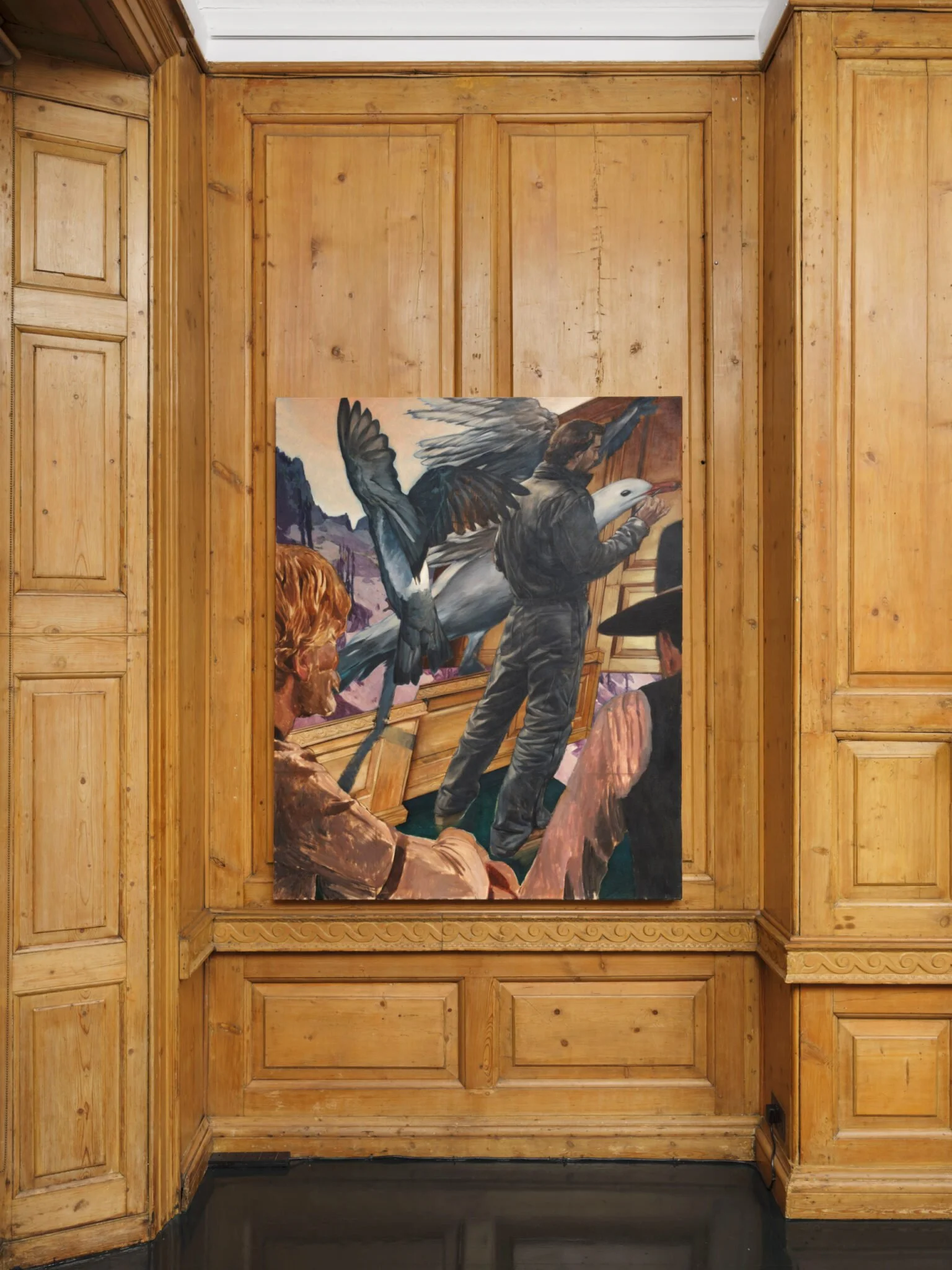
For his debut exhibition with the gallery, the artist has anchored many of the paintings in the architectural context of the gallery space itself, specifically ‘Miles City Saloon’, ‘Feather in the Cap’, ‘Post-War Painter and Dog’, ‘Meridian Drive’ and ‘The Hang’, creating a circular and dizzying trompe l’oeil effect for the show’s duration. The gallery space and its distinctive specificity (a Georgian former townhouse in Mayfair) is scrutinised as both the public site for these works’ display and as a private, looming spatial and emotional preoccupation. Rather than neatly containing the subjects of each work, the exhibition space itself becomes a metaphysical site of accumulation, co-opted into the kaleidoscope of the artist’s mind, alongside myriad art historical, filmic and personal references.
In ‘Miles City Saloon’, a group of figures sit at awkward angles to one another. The woman in the foreground, the artist’s girlfriend, is still, reading. A group of grayscale figures, including an American soldier, each inhabit their own individual space beside her, as if in a dream. A shadowy, Edward Hopper-esque figure stands in attendance at the bar. Three dynamic moving figures circle the seated, completing the ballet. Here, memory does not sit behind the present but alongside it, so that the image registers multiple presents at once—lived, inherited and imagined—without resolving their relation.
In ‘The Hang’, the figure crouching in the foreground was a close friend and colleague of the artist’s grandfather, who featured often in his photographs. To his right, the kneeling figure is a close friend of the artist, KV Duong. The painting he is handling is ‘Miss La La at the Cirque Fernando’ by Edgar Degas (1879), a work famous for its vertiginous feat of perspective. The play on two important friendships sits alongside the play on painting-within-a-painting, collapsing the distinction between artwork and artworld, defining images not as contained objects but as active agents in our experience. Past and present, private and public slip and overlap in this Proustian dance.
In ‘Wake’, this destabilisation takes on an even more explicitly art historical and physical dimension. Taking Andrea Mantegna’s ‘Lamentation of Christ’ (c. 1480), the artist faithfully represents elements of Mantegna’s masterful compression of the body into a shallow pictorial space, while intensifying its material presence. Flesh is rendered with heightened materiality and bodies appear simultaneously present and dissolving. The title implies a state of mourning, but the painting resists narrative clarity. Only Christ’s legs and his mother Mary’s face are faithfully reproduced. In place of Christ’s face is a tortured mouth, reminiscent of Francis Bacon, held open by threatening hands. A contemporary mournful figure lies to the right.
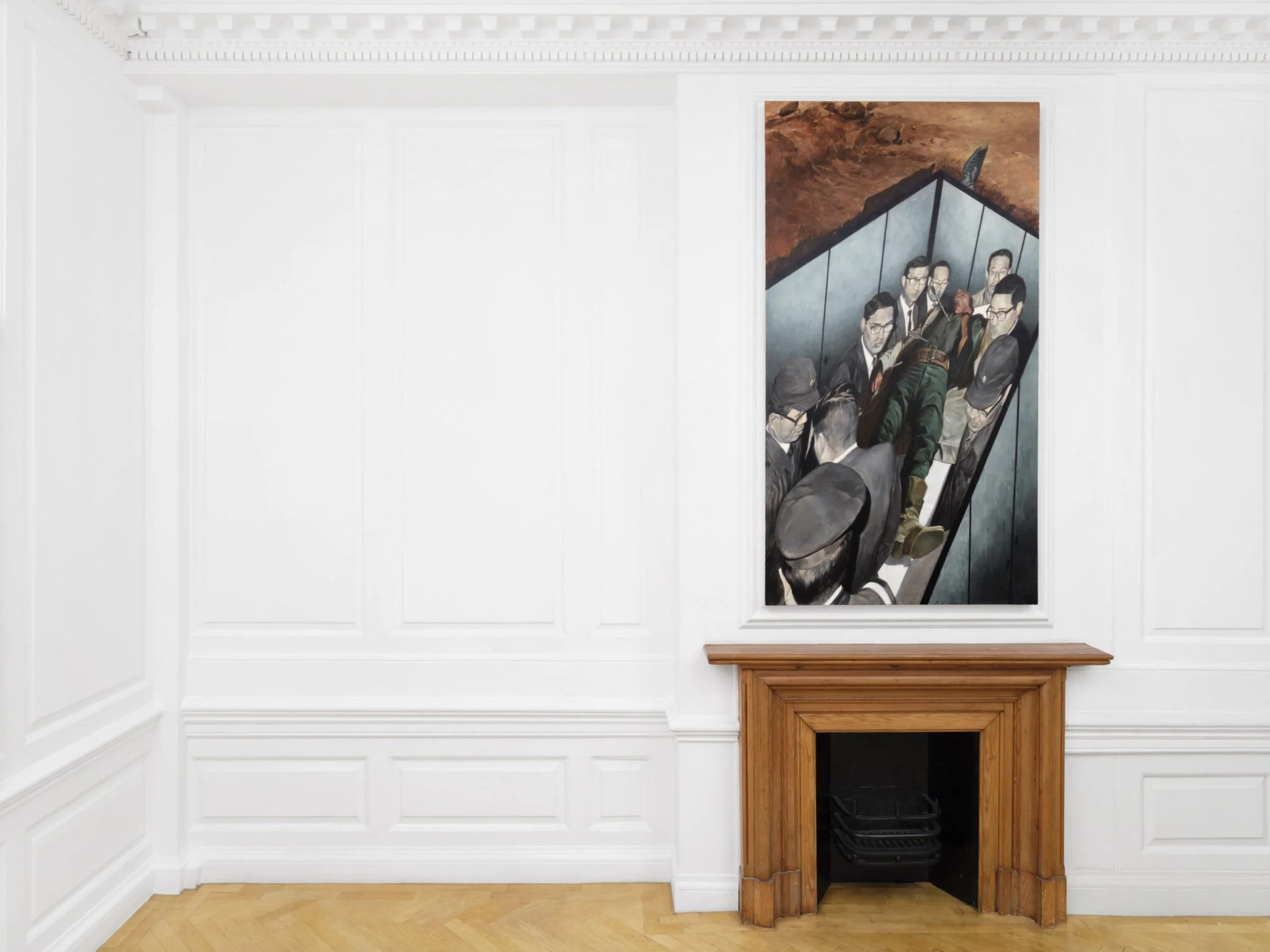
In ‘Liminal Procession’, Berkery takes a news image depicting the skewered body of Yukio Mishima (1925–1970), the influential Japanese novelist and playwright whose life was marked by an intense preoccupation with beauty, death and martial tradition, being carried, following his failed coup attempt and subsequent ritual suicide. These figures are recontextualised within the painting, with Mishima reimagined in the guise of a cowboy-cum-St Sebastian figure, borrowed from ‘The Good, The Bad and The Ugly’, collapsing distinctions between Japanese history and American myth. The dual identities that shaped the artist’s childhood are nowhere more acutely observed.
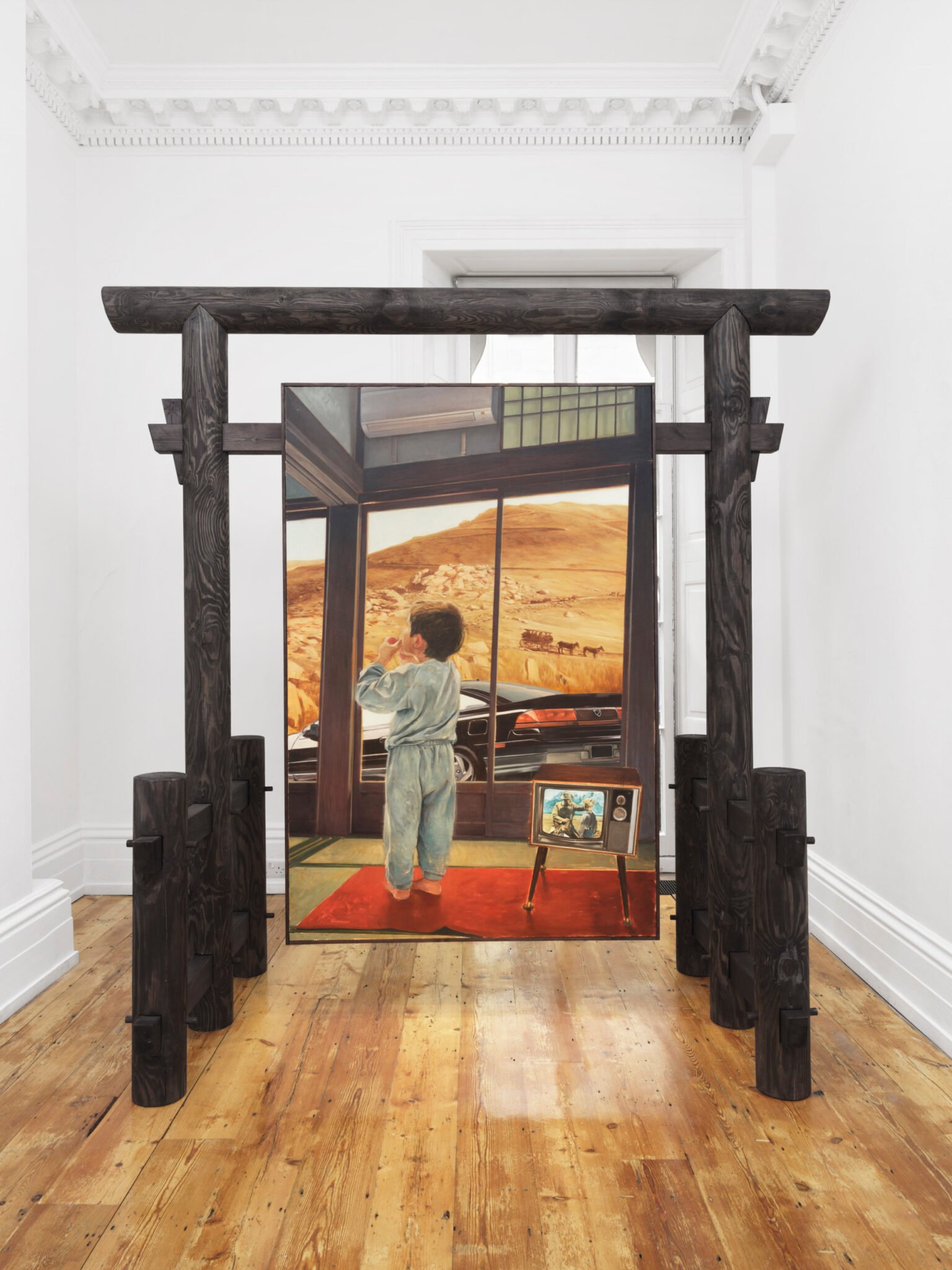
It is no accident that the Western film genre, and all its associated myth-building and rich visuals, serves as the scenic backdrop, as well the source of many of the characters for these works. The exhibition takes its title from the 1953 Western that shares the artist’s name, Shane, using the phrase shouted by the little boy at the gunslinging central character as he leaves town, wounded. Autobiography aside, the Western genre is largely responsible for creating, disseminating and reinforcing a notion of American identity as defined by the self-reliant hero, by moral clarity decided by action, by a distrust of institutions and by the land’s wide open scapes as the site of personal reinvention and freedom, achieved through struggle. In ‘Liminal Procession’ it clashes pictorially with its direct opposite, a manifestation of the ancient Japanese culture of duty, adherence to social hierarchy, public obligation triumphing over personal desire, rigid social codes and conflict serving rather to preserve order and honour.
In ‘Meridian Drive’, the artist appears himself centre stage in the main exhibition room of the Carl Kostyál gallery. Around his central figure, the image fragments, with a car interior, a rear-view mirror, and figures drawn from both life and memory. The sleeping boy reflected in the mirror is the gallery’s Stockholm director Gabriel Max Shelsky; the arm and hand holding a cigarette belong to Carl Kostyál. These are not incidental inclusions, but points at which the painting folds back into its own conditions of production and circulation. The rear-view mirror, in particular, becomes a device of temporal inversion—an image of looking back while moving forward—so that the work operates less as a coherent scene than as a diagram of consciousness.
Keisuke Berkery’s technical skill is deployed against illusionistic stability. Figures are often elongated, enlarged, or awkwardly positioned within space. Perspective is constructed only to be subtly undermined. The use of grayscale alongside colour creates a visual hierarchy of presence: some figures feel immediate and embodied, while others read as archival, ghostly, or imaginary. The surface of the painting itself begins to mirror the logic of contraction and release—tightening into density before opening again into ambiguity.
He does not seek to resolve these tensions. He treats image-making as “a site where private perception, cultural myth, and shared reality can meet, blur and be reconfigured.” The paintings hold contradiction in suspense. They are images of thinking—of a mind navigating a world in which memory, myth, history and media are inseparable. In this sense, painting itself becomes a threshold object. The artist’s achievement lies in recognising that this threshold is not a boundary to be crossed, but a space to be inhabited.”
– Katharine Kostyál
Info + opening times
Carl Kostyal