
Flowers, Cork St
Seeking New Landscapes
13.August.26 – 05.September.26
lowers Gallery presents Abstract Pairings, an exhibition that places two works by each of six British artists side by side, creating a sequence of encounters across different moments in their respective practices. Through the artists’ engagement with colour and their exploration of form and spatial rhythm, the presentation examines how both modern and contemporary artists articulate abstraction. The exhibition reveals how these artists have explored the fundamental principles of the genre through the evolution of their approach to painting.
Michael Kidner RA
A pioneer of Optical Art, Michael Kidner is recognised as a foundational figure in British abstraction, devoting much of his career to constructive abstraction. Both rational and playful, he combined visual responses to the principles of mathematics, science, and chaos theories with an abiding interest in the irrational and unpredictable nature of the human condition.
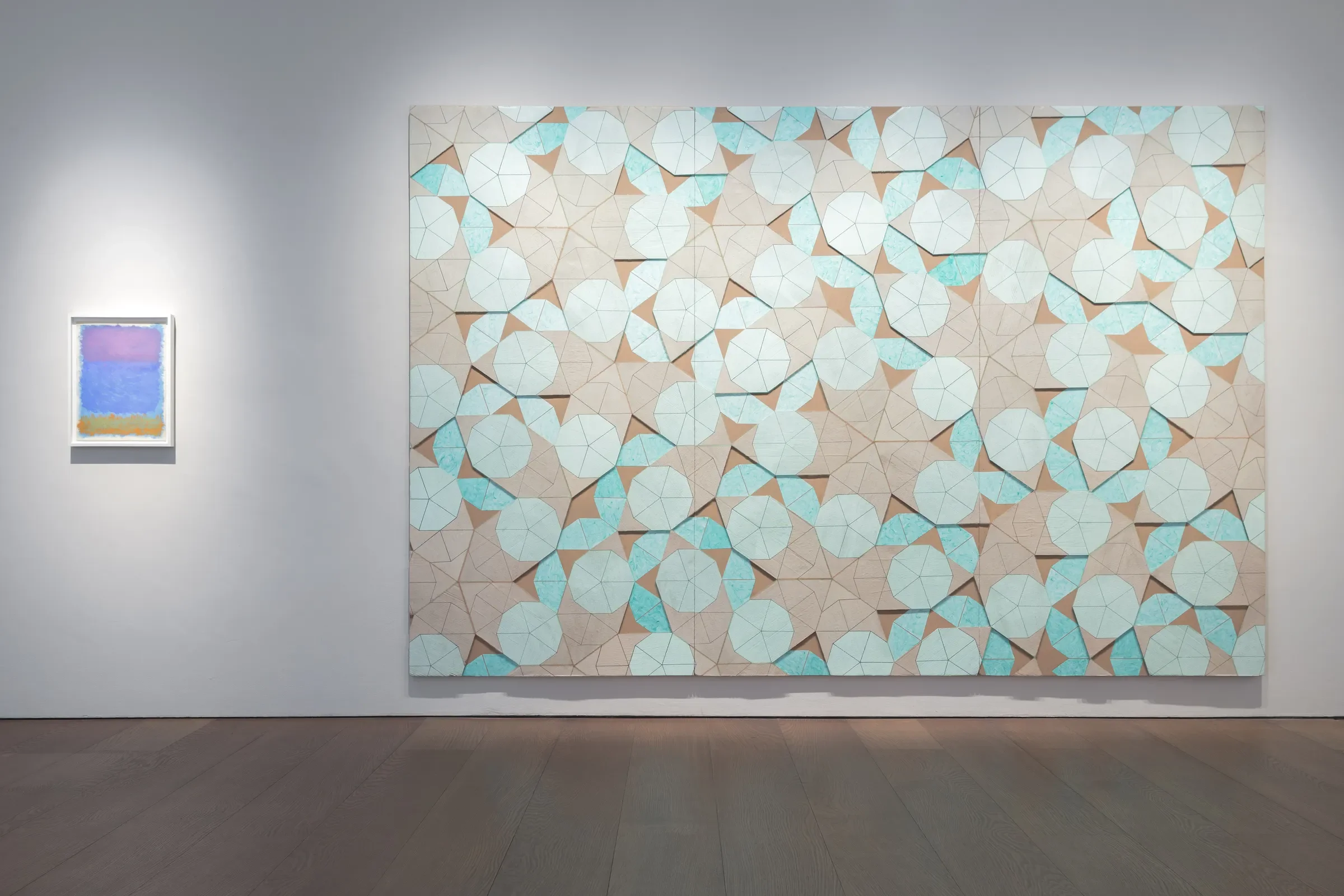
'Homage to Rothko' (1956) is part of an early series, After Image, influenced by Abstract Expressionism and Mark Rothko's colour fields. Kidner explored luminous planes of colour evocative of Rothko's spiritual abstractions. The painting captures Kidner's attunement to the psychological effects of varying hues, atmosphere and spatial ambiguity. This series reflects his early immersion in colour field painting and his growing understanding of colour as a source of 'pure sensation.'
Once I realised that my interest in colour rather than the figure or landscape could become the subject of a painting, I was off to a new start. An after-image was the purest experience of colour I could recall, and because it occurs on the retina of the eye, it looks brighter than any surrounding colour. However, it was too restrictive in its application to sustain my interest. -Michael Kidner
By 1999, the year Lilypond was completed, the chaos theory had a profound impact on Kidner's work, and geometric abstraction in the form of Penrose pentagons became a critical tool as a metaphor for organizing the disorder in the world. This new visual language was a response to the many dystopian world events, including global warming, conflict, and a rise in nationalism. Kidner was intrigued by the fact that his pentagon patterns appeared as whirlpools. The use of colour within the works was random, whereas previously in his oeuvre, colour was intentional and planned. He wondered if there may be in chaos 'some kind of order that perhaps we haven't yet recognised.'
Liza Giles
My works are driven by an impetus to 'switch off' and re-engage with our instinct. I want my art to speak honestly to its observer in a pure and simple way. My work is essentially about how it makes you feel. - Liza Giles
Liza Giles' artworks communicate directly through the use of colour, shape, composition and scale. The abstract, elemental forms found in her large-scale paintings developed from making smaller collages using found scraps and painted cut-outs. Set across multiple raw canvas panels, Giles intuitively reconfigures the paintings to produce new shapes and unexpected compositions.
Hampton and Melbourne are exemplary of Giles' use of a limited colour palette which is inspired by the natural landscape, using grass greens and sky blues, grounded by areas of unprimed canvas. These colours move across the surface with a quiet rhythm, creating a strong sense of push and pull between the positive and negative spaces.
Working flat to control the movement of the paint, Giles' oeuvre is characterised by an interplay between expressive feathered marks and formal hard-edge lines. Drawing inspiration from the architectural landscapes of London, where she lives and works, the paintings are imbued with a sense of light and space, as well as the immensity and solidity of the city's skyline.
Tom Phillips CBE RA
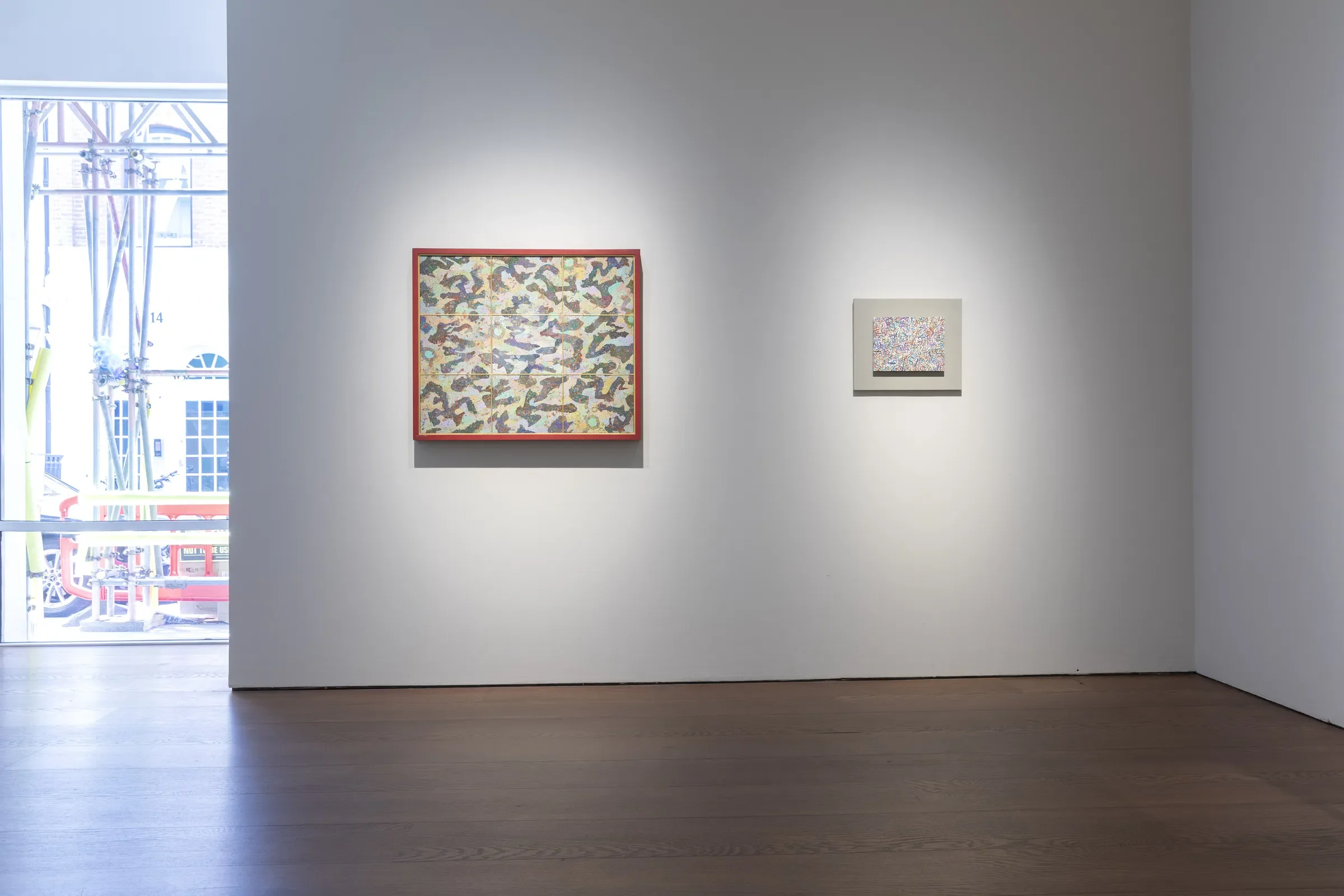
Tom Phillips' (1937-2022) Rilke's Angels (2009) and Stick Theory II (2012) encompass the artist's wide field of reference in science, literature, and music, as well as the world of dreams through abstraction. Rilke's Angels visualises a dialogue between dark and light and a conversation between large calligraphic forms and the intricate ornamentation of which they were made and which they inhabited. From close up it is a detailed hive of signs; these disappear from any distance, and overall it is seen as a simple dark on light design. The small patterning and colour shifts serve to vivify and energise the surface in general. The title refers to Rainer Maria Rilke's famous 1906 poem Die Engel (The Angels), which describes the angels as terrifying, awe-inspiring beings that represent the pinnacle of existence.
Without any plan shapes emerged like clouds forming and reforming. Each layer of the painting revealed the layers beneath in the form of dots or patterns or larger areas where I liked and left the accidents of colours already present; in effect an abstract palimpsest. -Tom Phillips, May 2008
Stick Theory II envisions the cross-ties between art and mathematical theorems, allowing the artist to rethink and reposition established ideas. The stacking of sticks in layers creates an exponential growth pattern, exploring the shapes and lines that are formed from the puzzle.
Carol Robertson
Carol Robertson's paintings remain firmly rooted within reductive abstract conventions; her current work still employs familiar geometric formations.
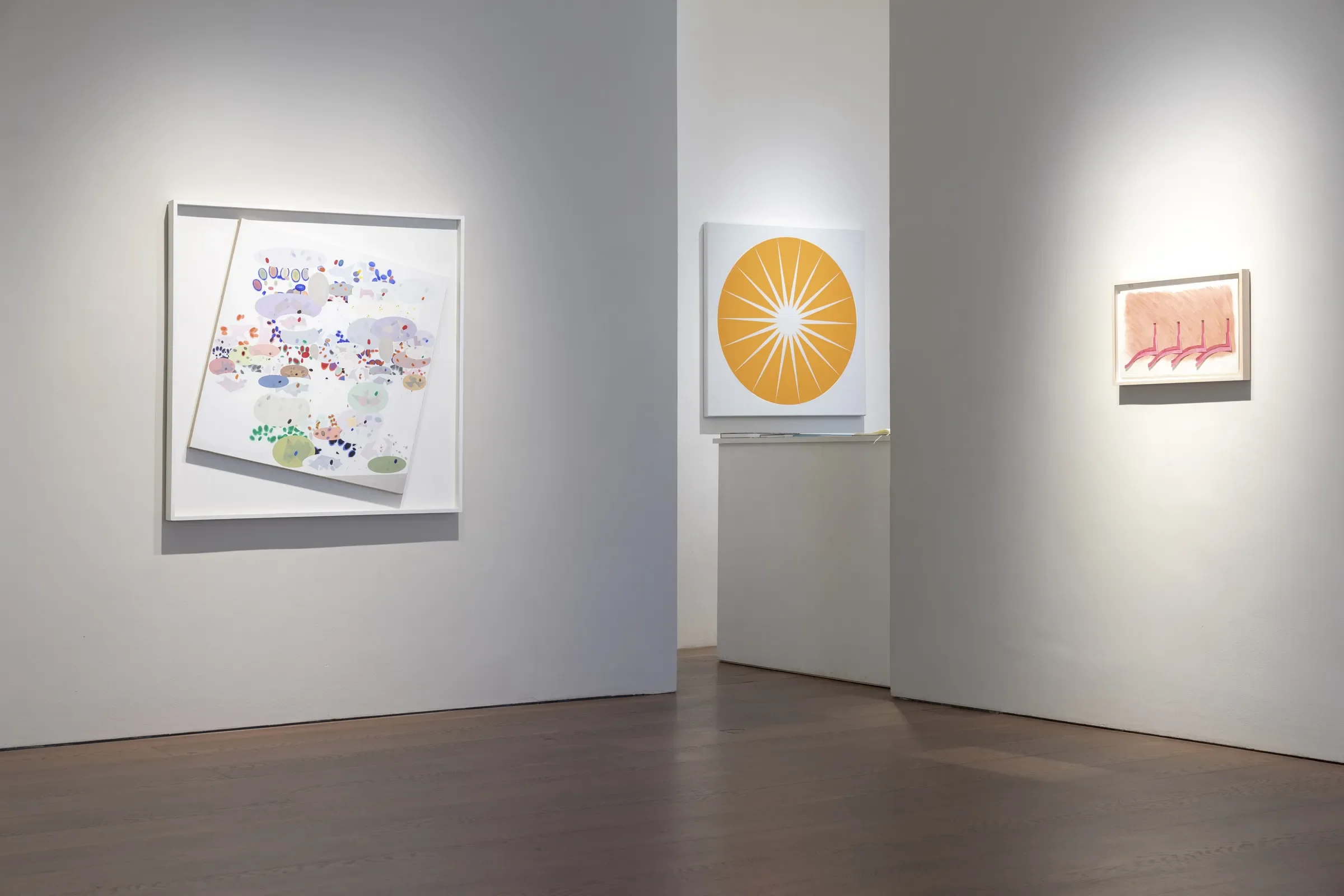
Light from Light (small) (2016) is an evocative piece composed of the elemental structure of the circle, encompassing a star shape. Working with a refined palette of orange and white, the artist believes in the powerful emotive and spiritual qualities of individual colours, using these to build complex layers of association. The star has eighteen points of sharpness, emphasising the expansion and shrinking of the centre-point and the subtle modulations of the orientation and density of line. The shapes are often set against shimmering unstructured grounds produced with poured layers of semi-translucent colour that create a resonant and harmonious whole, a process that Robertson describes as a 'consequential' way of working.
Completed in 2020, Phases #4 visualises the freedom which geometry provides to channel sensory or poetic material within its refined parameters. Colour is Robertson's key to unlocking her meditations; after preparing luminous hues of liquefied oil paint, she draws and then divides overpainted circles into narrow bands of alternating shades, resulting in a rotating dynamic that animates the geometry.
Bernard Cohen
Throughout his career, acclaimed artist Bernard Cohen (b. 1933) has been committed to moving his practice forward rather than revisiting earlier works. As his paintings became increasingly intricate, he placed growing emphasis on presenting viewers with what he described as 'authentic gestures,' allowing the creative process to remain immediate and responsive.
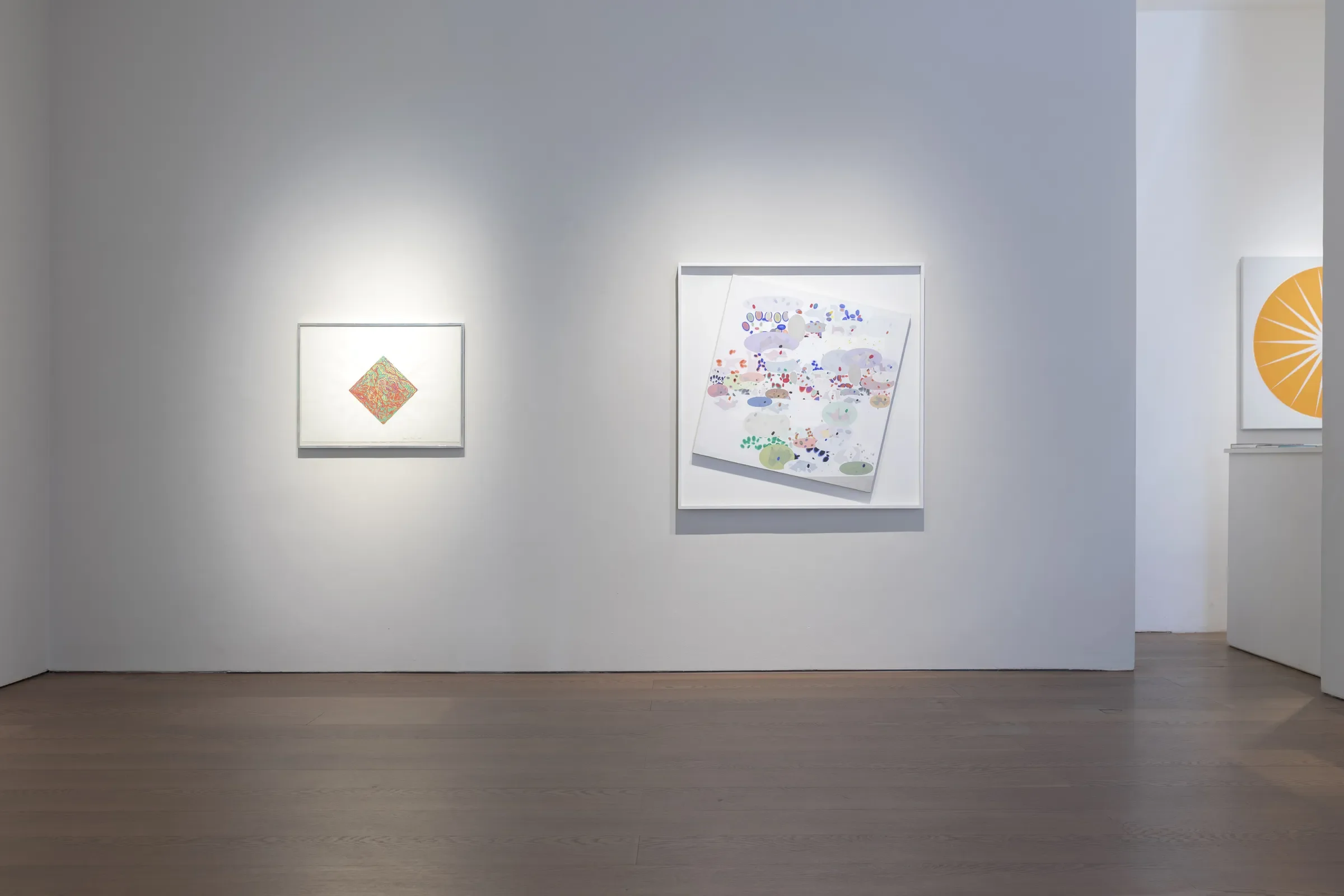
Five Full Size (1974) is part of a seminal body of work now included in the collection of Tate, London, and is an early example of Cohen's interest in clusters of paint situated within white canvases. These small bursts of colour emerge in the centre of the composition, beginning to spread out to the edges of the surface. Five Full Size is an illustration of the surface, physical density, and the maximum animation of pigment. This work is a continuation of Cohen's 'white' series from the 1960s in which he strived even further to position his painting into a substantially concentrated area, creating compositions inside one point of focus. Similar to the works from the 1960s, Five Full Size has an ambiguity of location both laterally and in depth. The motif of the disc obstructs any symbolic inference to be made, affirming the tactile process of making the marks by using a spray gun. The layers of discs are embedded into the white ground, unfolding as fragmented pigment deposits. The canvas is hung at a slight vertical tilt, reminding the viewer that the picture is an act of deliberate contrivance.
Untitled (1996) extends this investigation into concentrated pictorial structures. Dense groupings of colour emerge from expansive white space, where layered forms are simultaneously constructed and dissolved through successive applications of paint.
Richard Smith
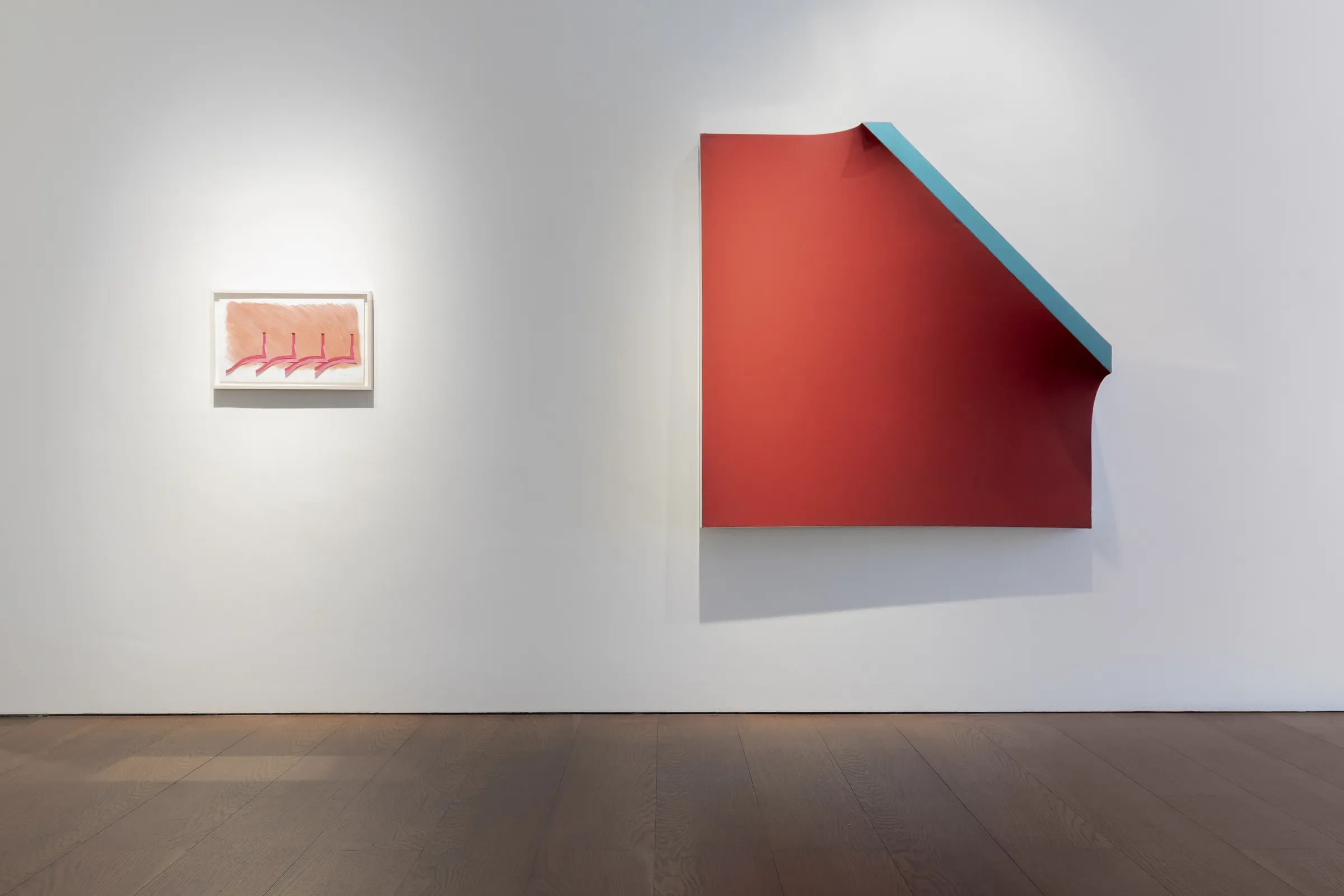
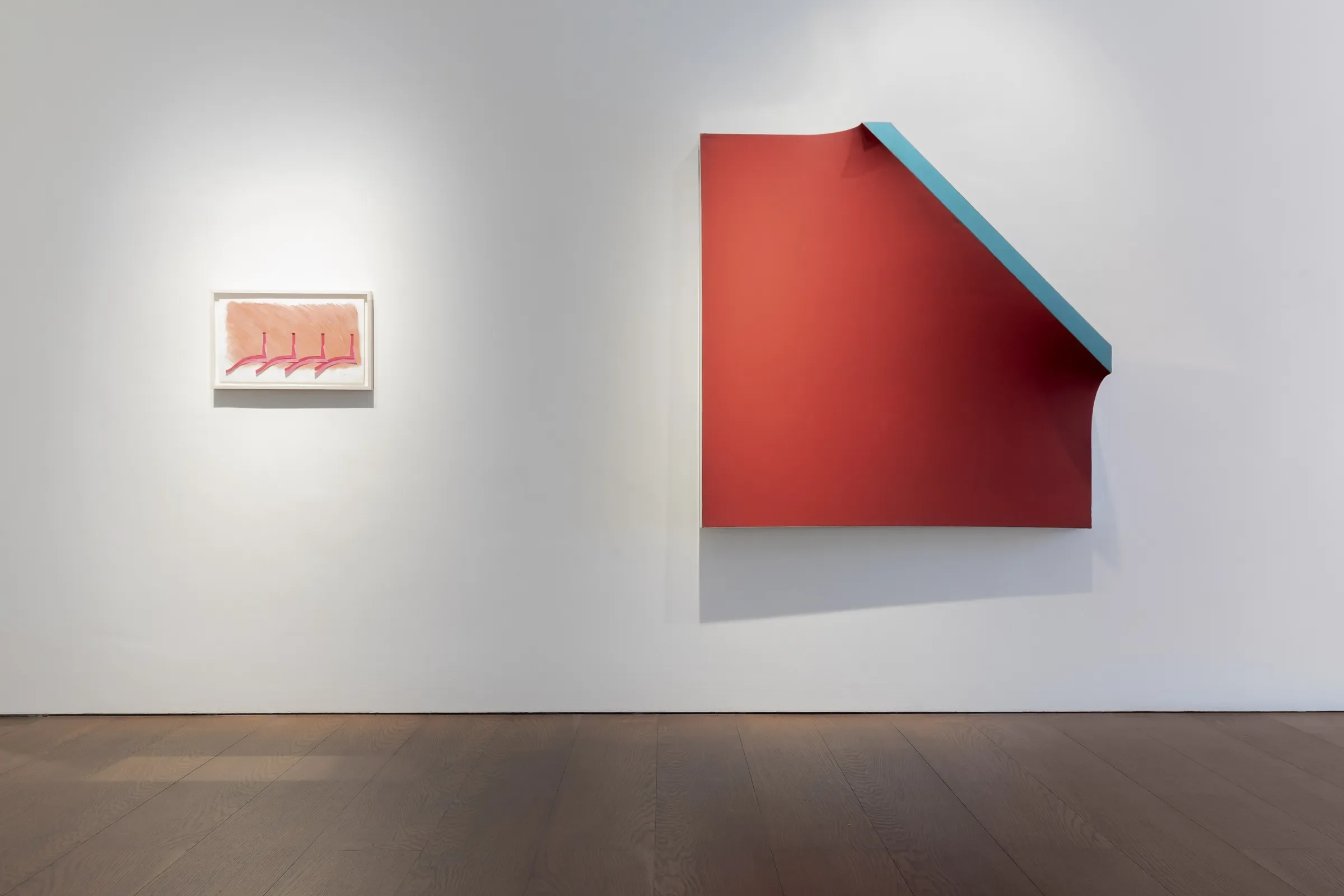
Recognised as one of the most influential artists of his generation and a key figure in the development of Pop Art in Britain, Richard Smith (1931-2016) created critically acclaimed sculptural-shaped canvases in the mid-1960s. A Whole Year and Half a Day VIII (1966), was formerly exhibited at his solo exhibition for the British Pavilion at the Venice Biennale in 1970. During this period, Smith created monumental wall reliefs which explored a radical new tension between volume, colour and surface. In A Whole Year and Half a Day VIII, the artwork appears to unfurl playfully from the wall, visualizing his interest in the depth and structure of three-dimensional objects.
First of all, I had to move into the shaped two-dimensional canvases because I wanted, always, to arrive at paintings of one thing, one image, making a complete unity, and therefore I eventually shaped the canvas to fit the image. The kind of images I was using then were based on cartons or boxes. The carton is an incessant theme in present-day civilisation: shops are full of boxes, and you see these before you see the goods; they practically stand in for the goods - it is not just a question of labelling or depiction. Everything comes in boxes: you buy boxes when you are shopping, you do not buy visible goods; you don't buy cigarettes, only cartons. The box is your image of the product. - Richard Smith, in conversation with Bryan Robertson, 1966.
The work on paper Abstract Design (1971), provides an enriching further insight into the protruding painting, exemplifying the ways in which the artst uses bold colour to delineate shapes, while also employing sculptural strategies such as cuts and folds, imbuing the flat surface with a remarkable sense of spatiality and form.
Info + opening times
Flowers, Cork St